How We Placed 45 Overseas Hires for Our Clients in 2025
Zack AllenFebruary 1, 20269:56
The numbers from our year, what worked, what didn't and what we're changing.
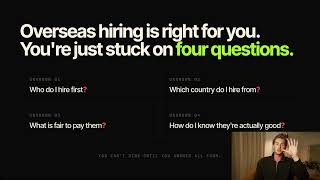
Last year my recruitment firm made 45 international placements for our clients. Here's what worked, what didn't, and the parallels I think apply to any business.
What we do
We launch recruitment campaigns for the specific role a client needs to fill, in countries where the US dollar goes further. We get hundreds or thousands of applicants, run them through our vetting, present only the top options, and place the hire in the client's business.
The numbers
- 56,000 applications.
- 382 interviews, all taken by me. I went back and checked.
- 45 hires.
- 91% of campaigns ended in a successful hire.
- 270 days, the average length of our clients' ongoing contracts with their hires so far, rising as more people hit one- and two-year marks.
Not data-entry VAs
We don't hire virtual assistants in the usual sense. Roles we filled in 2025 included sales reps, admin assistants, guest experience, onboarding, product research and business development. These are crucial to our clients' fulfillment and back-end operations.
Where we find people
Facebook ads, LinkedIn ads, posting on LinkedIn (a surprisingly good talent funnel), Indeed, niche Facebook groups where the ideal applicant hangs out, our newsletter of remote workers, and outbound on LinkedIn and our database for roles that need very specific experience.
How we hit 14 days
Every campaign runs on a 14-day deadline. That takes a lot of support:
- Same-day launch once the role and agreements are set.
- A fast application, cut down over the years to the steps that produce a clear yes or no.
- AI assistance, using past successful placements as context. We don't hand the decision to AI, because AI can be very stupid. It augments the manual review.
- Reviews and interviews seven days a week.
- Time gating: strict deadlines at each step, like 24 hours to finish a stage, and interviews only bookable within three days.
We haven't hit 14 days every time, but it's worked well.
What didn't work
Our applicant system. I'd been using a tool that wasn't built for applicants. Instead of shopping around, I built one in-house and had a working prototype within 24 hours, replacing software I'd paid hundreds a month for.
Long interviews. Hour-long interviews felt like asking clients to watch a movie. I cut them down to the questions that produce polarizing answers, where it's obvious whether someone fits.
Client pivots. Several placements ended for reasons unrelated to performance, because clients changed financial direction.
The lowest salary range. We never hire $2-an-hour talent. But early on we allowed $3 to $4 an hour, and the work to filter out the good candidates was about triple what it took at a higher range. Setting a salary floor produced much better results on all sides.
What worked
Success-based pricing. My incentives are tied to the result, not my time.
In-house software. I can ship what I want fast, like AI guards so people can't use AI to get through the application.
Vetting clients. We don't take everyone. Each campaign takes resources, and our reputation depends on clients who are good leaders.
Character focus. Skills can be taught. Character and attitude can't. We vet for the intangibles that don't show up on a resume.
More countries. Our core is the Philippines, but in 2025 we hired in South Africa and Colombia. Different countries excel in different areas.
Leaving training to the client. Standardized training usually isn't how our clients work, and it would limit us to roles where I'm a domain expert.
2026
Two priorities. First, keep improving our internal tools. Second, delegate initial interviews. Taking all of them myself made me the bottleneck. My team is building that intuition through reps: seeing applications again and again, taking interviews that go well and poorly, and studying which placements thrived and which ended, so we catch the green and red flags earlier.
Transcript
Show the full transcript
Last year in my recruitment firm, we made 45 international placements with our clients. I make this video today to break down a little bit about what worked well for us, what didn't, because I think there's a lot of parallels you can apply to your business. And maybe one day you work with us to build your international team because that's what we do for our clients. Some photos here for proof. This is a couple faces from the talent we have placed.
And this is my team that helps you run all the backend operations, keep everything supported smoothly. So first thing I'll cover briefly is what we do, what our business model is to give you more context on this whole process. So we launch recruitment campaigns specific to the role our clients are trying to fill. We launch those in in international countries to currency arbitrage get more affordable labor than the US. We get hundreds thousands of applicants.
We run them all through our vetting process so that the client is only presented the top options that we have decided are the best fit for the role and then we place those inside of the client's business. Now, some numbers behind it. Last year, we got 56,000 applications. I personally took 382 interviews. I went back and checked the numbers just now. And from that, we made 45 hires. From the campaigns we launched, we had a 91% success rate.
So 91% of campaigns ended up in a successful hire. And of the contracts we have ongoing, our clients have with the talent, we're at an average length of 270 days. And that's going to increase every day as we hit more one year, two-year marks. So as it sounds like already, you might have noticed, we do not hire virtual assistants. Some of the roles that we filled in 2025 include sales reps, admin assistance, guest experience, onboarding, product research, business development, and on.
These are roles that are crucial to the fulfillment and the back-end operations of the clients that we worked with. These are not data entry VAS. So, just because you're hanging internationally, it does not mean that we had to, you know, only focus on ones where it's like oneplus 2. And we launched these campaigns using a few different mechanisms. First would be Facebook ads, LinkedIn, LinkedIn ads as well as I found posting on LinkedIn to be a pretty good talent funnel.
Indeed, obvious one, Facebook groups, so niche groups specific to the role where the kind of ideal applicant would hang out, posting it in there, sending it out to our newsletter. Over the past couple years, we've cultivated a bit of a newsletter of remote workers that we send it out to and then outbound for roles that require very specific experience using LinkedIn and using our own personal database, people that have applied in the past to get them to apply to this new job that we are recruiting for.
Now, all of our recruitment campaigns run on a 14-day deadline. That's pretty quick compared to other recruitment firms. Some of them will give you like, yeah, we'll find someone in the next couple months hopefully. But ours is 14 days. We want it to be as quick as value to possible for our clients. And there's a lot of stuff that has to support that in order for that to be the outcome. First one is a same day campaign launch.
When we take a call with the client and they say, "Here's the role we're looking for. Here's what's important to us." After we get, you know, the the specifics, the agreements arranged, then we launch the campaign same day using those mechanisms in the previous step. From there, our application process is very quick, but not at the detriment of having bad vetting, but we've just iterated over the years to make it so that it's only the polarizing steps of the vetting process that make it a clear yes or no, not like filler questions.
Like, it's very efficient. We've integrated AI assistance in order to make that deadline quick. not fully delegating the decision-m to AI because AI can be very very stupid but using it as an augmentation to our manual process especially using the past context of placements that have done well you know what did they answer to this question how did they respond here we review applications and take interviews 7 days a week so we are able to move the process forward at all times time gating so different steps of the application process have strict deadlines.
It's like you need to finish this in 24 hours to be considered for the role and a 3-day calendar window for our interviews. That is the one that is, you know, requires most of our time consumption on my team. And I only allow them to book within 3 days from now. And so all these things combined together make it so we can hit our 14 dead 14-day deadline consistently. Of course, there's times where we haven't, but that has worked fairly well for us.
In 2025, what didn't work? Why was our placement count not higher? The first thing that really broke was our applicant system. Previously, I was using a one that wasn't even made for applicants, but it got the job done, but there very many shortcomings. And so, I got to the point where I could have found, you know, shopped around, found one that worked well. But instead, I made the call to build it in-house.
And within 24 hours, I had a working prototype of the same software. I was paying hundreds of dollars a month for previously. It meant I was also able to be very granular on this different features that I wanted implementing what I thought was going to produce the best outcome rather than having to wait for like a feature request. What didn't work was having longass interviews. I would present options to our clients and there'd be like an hour each and it felt like they're watching a movie.
It's like so much to commit to. So, I figured out how to get my interview shorter by focusing on the questions that only again produce polarizing answers. One where it would be very obvious to tell if they were a good fit from these questions, not ones where I kept getting the same answer every single time. Company pivots did not work well for us, not on our side, but on our clients. So, this led to several placements being terminated, unrelated to performance because they took a different financial direction.
And lastly, scouting in the lowest salary range. Now, of course, we don't hire the $2 an hour talent. That's a mistake. But we we did have a little more lenience in the beginning of like the $3 to $4 an hour range. And after running the numbers, I found that the backend fulfillment required to like filter down just the good ones was like 3x if I just raised the salary range. And so once I I just set a minimum of like this is the lowest we're going to go and it produced much better results on all ends.
What did work well in 2025 that allowed us to achieve 45 placements was first our success pricing structure meaning our my incentives are aligned to the outcome to the result. They're not my clients are not paying for my time in the process. Building that in-house software meant that I could implement things that I wanted to see very rapidly. So for example, different AI implementation, AI guards so that people can't just use AI to complete the application process.
Client vetting meaning we don't just take on anyone and everyone that'll give us money. having some sort of specific specificity in the clients that we're launching campaigns for because I have to invest the resources into launching it, but also because from a long-term reputation perspective, I don't want to have it, oh yeah, this client like was terrible. They were very rude. They weren't a good leader. And so what worked well was having some sort of vetting in place on that initial call to see what kind of person they were.
Due diligence, character focus. So, I'm a big believer that skills can be taught, character, attitude can't. And so, having that as a core focus of our application process outside of just the skills, the things, the intangibles that don't show up on a resume. Expanding countries worked well. So, our core is in the Philippines, but in 2025, we hired in South Africa, Colombia, and that was able to produce great talent for these specific roles we were scouting for. different countries excel in different areas and not providing training there if we implement like you know some some standardized training first of all it's usually not the way our clients would do it and second of all I have to be a domain or I have to be an expert in that domain and it means I'm only limited to those roles and so I find leaving the training up to the client to the business owner produced the best results on all ends so what now in 2026 I plan to iterate on those internal tools I spoke about making the process easier and a better result for all ends delegating the initial interviews.
So those 300 something interviews I all took myself and it meant that event like this year I will become the bottleneck I have become the bottleneck of moving the application process forward is because I have to sit on all these interviews and it's not the best use of my time. So now we're working on delegating those to my team, putting in the reps and building that intuition very very important because I can put stuff in a document but that doesn't teach like them in subconsciously how they uh approach the recruitment process.
So building the intuition through seeing applications come through again and again again taking interviews that go good and that go poorly and seeing the placements that became very successful. What can we pick up in the process before the green and red the green flags and then the ones that did really poorly, the ones that ended and terminated. What were the red flags that we could have picked up earlier in the process?
Hope this has been valuable to you and whatever your business is. I'll see you in the next video.